

Canoe is an unincorporated community in Escambia County, Alabama, United States.Originally called Canoe Station, the settlement was a stop along the Mobile and Great Northern Railroad.
During the American Civil War, Confederate forces operated out of the area and on March 27-March 28, 1865 10,000 Union soldiers camped in Canoe during the Canoe Rendezvous. During this 24 hour period several Union commanders brought together their forces which had been operating in the area and then moved on towards Blakely, Alabama. Gen. C.C. Andrews mentions this period in his book, History of the Campaign of Mobile.
The settlement grew into a town and prospered from the 1870s-1950s. New settlers came during the 1880s-early 1900s in search of cheap, cut over timberland on which to build homes and farms. The town was the site of 3 schools, a mineral spring, and a hotel, among other businesses. By the 1960s, Canoe was in an economic decline as store keepers aged, closed up shop, and as younger people moved from the town. The post office and public schools closed by the 1970s.
Today Canoe, Alabama has a population of several hundred with a half dozen shops and businesses, a private school, and a water system.
The dialog below mentions Robert McNeil (Chesters Uncle).
WOULD YOU BELIEVE THERE WAS CANOE BEFORE THERE WAS ESCAMBIA COUNTY ?
By Mrs. C. W. Young, Jr.
Before there was an Escambia Co. Al, there was a Canoe AL!
Quoting from R. W. Brooks, a pioneer Baptist preacher who really knew this area and the people in it better than anyone else that we know of, When he was writing in his newspaper column about the formation of the County in 1868, he said:
“… at the time Brewton was the forks of the creek, Pollard was the County seat, Flomaton was not started, and Atmore was a wide place in the woods. Andrew Jackson Hall Sr.’s family, so far as I can determine, was the first family to move to this area. He had moved here from the northern edge of Florida- Oak Grove-by 1852, for it was that year that his son Wiley C., was born here. The first Hall home was the large old wood frame house which stood, until recent years, slightly northwest of where the water tower stands today. (The same house , incidentally, that my father and mother, Dr. and Mrs. J.P. Stallworth lived in when they first moved here in 1907. The same house that the Cardens lived in around 1925.) ” Other families who had settled in this same Township and owned land by 1860 as shown on the plat, included William Henry Harrison Leatherwood (Father of Neal Leatherwood), who settled in what we know know as Moyeville, William Miles (Miles Horn’s grandfather) south of where Sardis Church is now. Elizabeth Franklin and James Miller (of who I have no knowledge).
This AL. and FL. Railroad had completed its line from Montgomery to the AL.-FL. Line, Via Pollard, about May 3, 1861. And by the latter part of that same year the Mobile and Great Northern Railroad Co. had competed its line from Pollard to Tensaw River which passed through what was a little later named Canoe Station for Canoe Station for Canoe Creek. It was Andrew J. Hall who was credited with naming the settlement around the Railroad station.
This Andrew Jackson Hall, Sr., (1820-1885) had married Mary Lucinda (Entrekin) Vickery, a widow, whose son , John Wesley Vickery, moved to Canoe in 1852 with them and their 3 sons born in FL., three more sons were born in Canoe.
It was on Jan. 29, 1860, that Andrew Hall filed a land application for the north half of Section 25, township 1 north, range 6 East in canoe, or what has been known as the Bachelor Farm in Recent years.
Of Andrews Halls six sons, two settled down to live here. They were Andrew Jackson Hall, Jr., called “Jackson” (1851-1916) and Wiley C. Hall (1852-1921). Jackson married Lizzie Brown and had 6 sons and five daughters. Wiley C. Hall married Charlie ? and had one daughter, Pearl, who married Bernard Gate, a long time telephone operator in canoe. (They were the parents of Bartley Gates of Atmore.)
A Sunday outing, Residents in the Canoe area spent a leisure Sunday afternoon at Mineral Springs. They came in horse and carriage and some in autos.
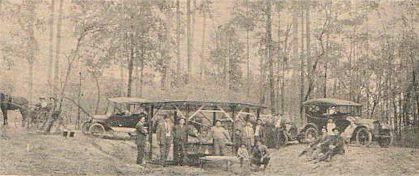
Mineral Springs. They came in horse and carriage and some in autos.
Jackson Hall and his wife married in 1874 and built their home in about 1876. Of the eleven children, four remained in Canoe until their deaths. Mattie Pearl (1880-1910) married Burton Lee Middleton and died leaving no children. Carroll “Buster” Hall married twice, first to Marie Watson and second to Marie Findley, he died leaving a widow but no children. Corry Hall married Alba Mosely. They had 2 children, Farrar Hall, Killed in a air plane crash while in service during WWII, and Barbara married Doug Prather. Andrew Arthur (1882-1934 married Lucille Watson. He was a farmer and cattleman. They had four daughters and one son: Mary Nan married William Vickery; Jerrelyn married Sam Love; Anncille married John E. Conn, Jr. and had no children; Arthur James Hall married the former Sarah Rutherford of Franklin, their children were Lynn, Susan, Carolyn, and Jim, the fifth generation of Halls to have moved to Canoe. Jim moved to Atmore after his marriage to the former Ann Fulghum.
One other family dates back nearly as far as the Halls and have added much history to the town.
This was the family of Mrs. Keziah Lowery, a widow with a lot of spunk, her family had lived in the booming town of Evansville, which had sprung up around the saw mill near the old Miles Crossing- very near to the Sardis Church in 1868 and had vanished just as fast as 1871 after the mill burned. Her husband, Andrew Monore Lowery, died in 1871 and she moved to Canoe with her very large family. Three of her children homesteaded in Canoe– Andrew Madison Lowery, Mrs. Dunaway and Mrs. Dawson. Andrew Lowery married Mildred Teresa Bryars and raised a large family here. Two of them continued to live here and brought up their families here– Herman Lowery and Vergie Lowery. Allene returned to make her home here again– she married S. C. Wilson. Vergie married Robert L. Lowrey– not changing her LAST name but rearranging the spelling of it ! Robert was the son of A. L. Lowrey, remembered by some as “Fate Lowrey”. Robert Lowrey had a long record of being a store keeper and postmaster for about 20 years. The children born to Mr. and Mrs. Robert Lowrey were forth generation of Lowerys living in or close to Canoe, for his grandfather, W.R. Lowrey, has settled near Robinsonville in around 1898. There were five boys & two girls in that generation: Clyde, Mozelle, Edward, Gerald, Peggy, Charles and Bobby. The oldest four boys were in the armed services during the WWII– all at the same time! The fifth generation that lived in Canoe were the children of Bobby– Charlotte, Wanda, Sandra and Paul. Bobby moved to Pensacola. Leo Lowery is the only descendant of W.R. Lowrey living in Canoe. (There are others at Atmore). There were a number of Lowrey girls who married a Stanton, Ballard, McKinley, Pearson and in the next generation a Black.
Around the turn of the Century a number of families moved here from Monroe and Wilcox Counties. It was then that some of them organized a canoe Methodist Episcopal Church. It was really organized in Robinsonville– at the schoolhouse– with the land there nearby to build on, but it was decided that Canoe was more Centrally located and so it was built here instead. That was in 1900. The plentiful trees attracted saw mills, turpentine stills, lumber co., commissaries, then workers in these businesses. — I couldn’t possibly name them all but there came W.H. Pebbles, P. E. Stanton, Jim Bristows, Jim Robinsons, Dr. Garrett, a dentist, Dr. J. P. Stallworth, The W.D. Farrars, Joe Davidson, R. L. Lowreys, the Fountains, Troutmans, Myricks, Rigbys, Watson, Henry, Foote, Jack Mims– the McNeils, Dave, John & Fred, Etheridges, W. H. James, J. B. Ray, Salters, Baggetts, Grahams, Lees, Findley’s, McClendons, Stillings, Hills, Nalls, McMurphys, Davises, the Robert McNeil, the Abrams, and the Mixons. To those I failed to mention or got the facts a little wrong, I am sorry.


Leave a comment