

An ahnentafel (German for “ancestor table”) is a way of numbering a person’s direct ancestors using a fixed mathematical pattern, rather than listing them in a tree diagram. It’s widely used in genealogy because it lets you represent a whole ancestral line as a simple numbered list — useful for indexing, printing, or storing in a database.
The numbering rule is simple:
- The subject (the person whose ancestry you’re tracing) is #1
- That person’s father is double the number: 2
- Their mother is double plus one: 3
- Every subsequent ancestor’s father is 2n, and their mother is 2n + 1, where n is that ancestor’s own number
This means:
- All even numbers are male, all odd numbers (except #1) are female
- You can always find someone’s parents by doubling their number (and adding 1 for the mother)
- You can always find someone’s child by dividing their number by 2 (rounding down)
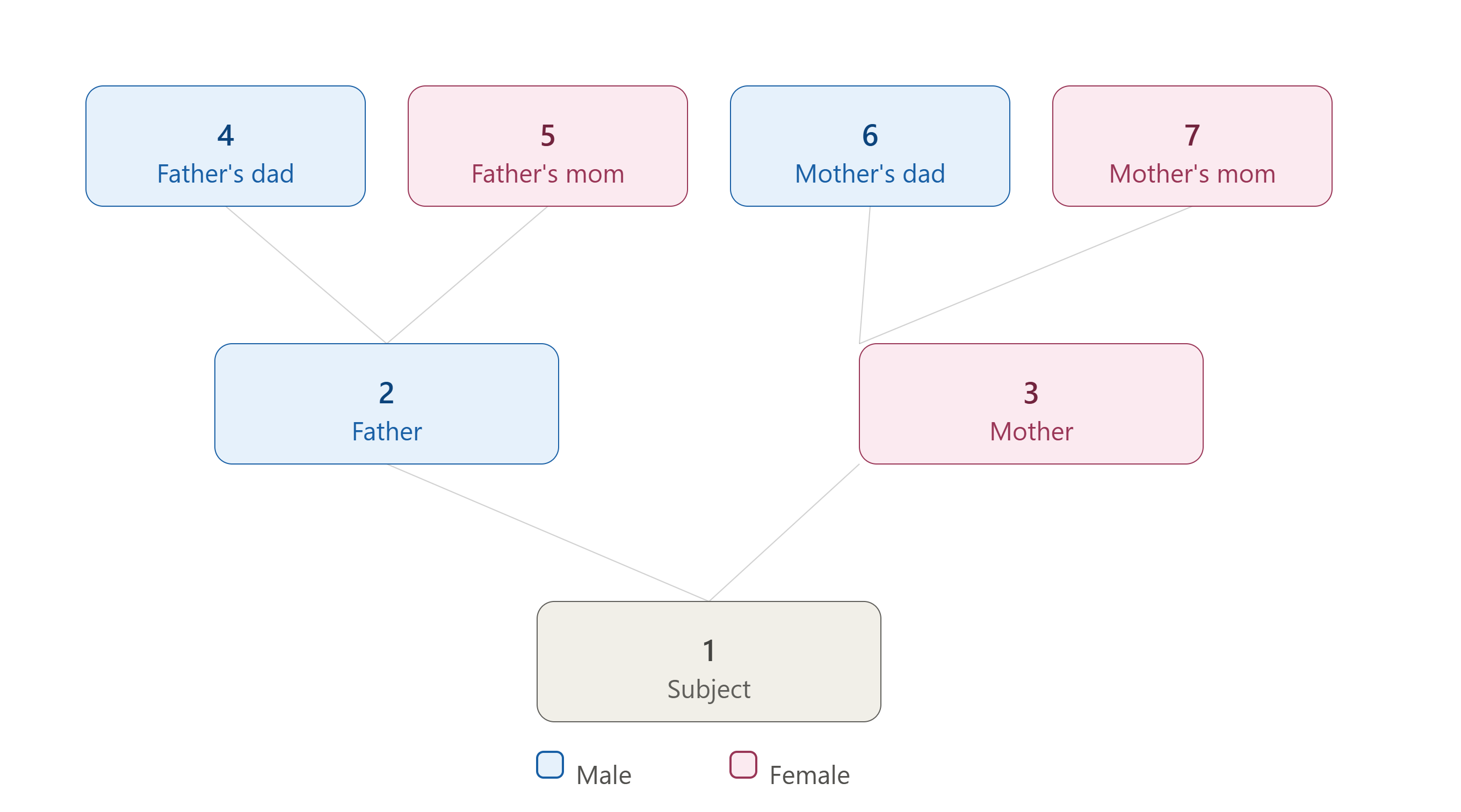
As you can see, each generation’s numbers are simply double the child’s number (father) or double plus one (mother) — so a fourth generation of great-grandparents would run 8 through 15, continuing the same pattern indefinitely up any family tree.

