


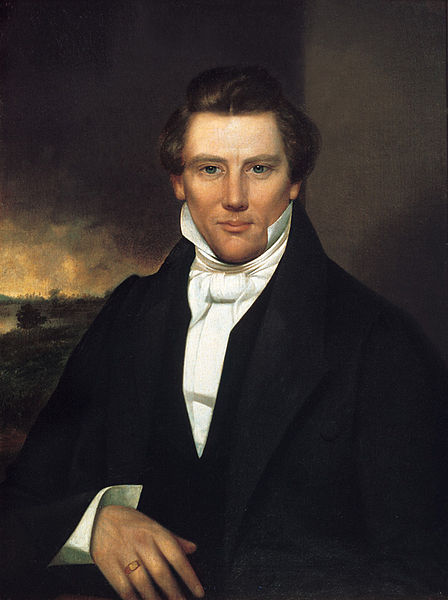
The Church of Jesus Christ of Latter-day Saints traces its current dispensation beginnings to Joseph Smith, Jr. on April 6, 1830 in Western New York. Initial converts were drawn to the church in part because of the newly published Book of Mormon, a self-described chronicle of indigenous American prophets that Smith said he had translated from golden plates.Smith intended to establish a New Jerusalem in North America, called Zion. In 1831, the church moved to Kirtland, Ohio (the eastern boundary of Zion),and began establishing an outpost in Jackson County, Missouri (Zion’s “center place”),where he planned to eventually move the church headquarters. However, in 1833, Missouri settlers brutally expelled the Latter Day Saints from Jackson County, and the church was unable via a paramilitary expedition to recover the land. Nevertheless, the church flourished in Kirtland as Smith published new revelations and the church built the Kirtland Temple as the site of what they viewed as a new Pentecost. The Kirtland era ended in 1838, after a financial scandal rocked the church and caused widespread defections. Smith regrouped with the remaining church in Far West, Missouri,but tensions soon escalated into violent conflicts with the old Missouri settlers. Believing the Saints to be in insurrection, the Missouri governor ordered that the Saints be “exterminated or driven from the State”. In 1839, the Saints converted a swampland on the banks of the Mississippi River into Nauvoo, Illinois, which became the church’s new headquarters.
Nauvoo grew rapidly as missionaries sent to Europe and elsewhere gained new converts who then flooded into Nauvoo. Meanwhile, Smith introduced plural marriage to his closest associates. He also established ceremonies, which he stated the Lord had revealed to him, to allow righteous people to become gods (joint heirs with Christ)in the afterlife,and a secular institution to govern the Millennial kingdom. He also introduced the church to a full accounting of his First Vision, in which two heavenly “personages” (LDS interpret them to be God the Father and his Son, Jesus Christ) appeared to him at age 14. Long after Smith’s death, this vision would come to be regarded by the LDS Church as the most important event in human history after the resurrection of Jesus.
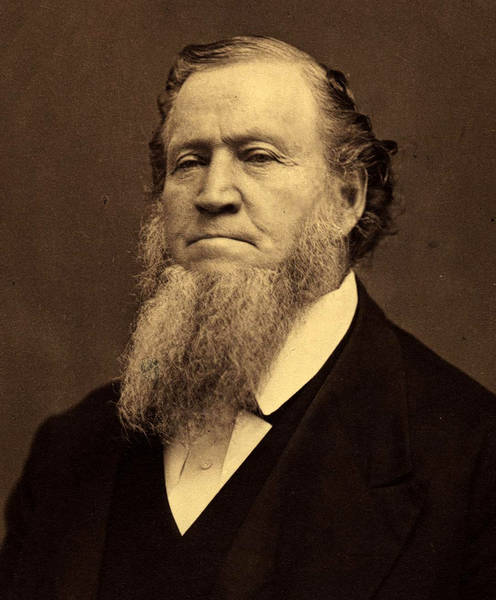
On June 27, 1844, Joseph Smith and his brother Hyrum were murdered by a mob in Carthage, Illinois, while being held on charges of treason. Because Hyrum was Joseph’s successor, their deaths caused a succession crisis, and Brigham Young assumed leadership over the majority of Saints. Young had been a close associate of Smith’s and was senior apostle of the Quorum of the Twelve. Other splinter groups, excommunicated from the Church of Jesus Christ of Latter Day Saints, followed other leaders in their own interpretation of the Latter Day Saint movement.For two years after Smith’s death, conflicts escalated between Mormons and other Illinois residents. To prevent war,Joseph Smith had predicted that the church would go to the West and be established in the tops of Rocky Mountains. Brigham Young took Smith’s advice and led his followers, known in modern times as the Mormon pioneers, to Nebraska and then in 1847 to what became the Utah Territory. As groups (over 60,000) arrived over a period of years, LDS settlers branched out and colonized a large region now known as the Mormon Corridor.
Young incorporated The Church of Jesus Christ of Latter-day Saints as a legal entity, and initially governed both the church and the state as a theocratic leader. He also publicized the sacred practice of plural marriage,a form of polygamy.
By 1857, tensions had again escalated between Mormons and other Americans, largely as a result of accusations involving polygamy and the theocratic rule of the Utah territory by Brigham Young. The Utah Mormon War ensued from 1857 to 1858, which resulted in the relatively peaceful invasion of Utah by the United States Army, after which Young agreed to step down from power and be replaced by a non-Mormon territorial governor, Alfred Cumming. Nevertheless, the LDS Church still wielded significant political power in the Utah Territory.
At Young’s death in 1877, he was followed by other LDS Presidents, who resisted efforts by the United States Congress to outlaw Mormon polygamous marriages. In 1878, the United States Supreme Court, in Reynolds v. US, decreed that “religious duty” to engage in plural marriage was not a valid defense to prosecutions for violating state laws against polygamy. Conflict between Mormons and the U.S. government escalated to the point that in 1890, Congress disincorporated the LDS Church and seized all its assets. Soon thereafter, church president Wilford Woodruff issued a Manifesto that officially suspended the practice. Although this Manifesto did not yet dissolve existing plural marriages, so that families would not be split apart or damaged, but no new polygamous marriages would be performed, relations with the United States markedly improved after 1890, such that Utah was admitted as a U.S. state. Relations further improved after 1904, when church president Joseph F. Smith again disavowed polygamy before the United States Congress and issued a “Second Manifesto” calling for all plural marriages in the church to cease, as they were already against church doctrine since Woodruff issued the Manifesto. Eventually, the church adopted a policy of excommunicating its members found practicing polygamy and today seeks to actively distance itself from “fundamentalist” groups still practicing polygamy.


Leave a comment