


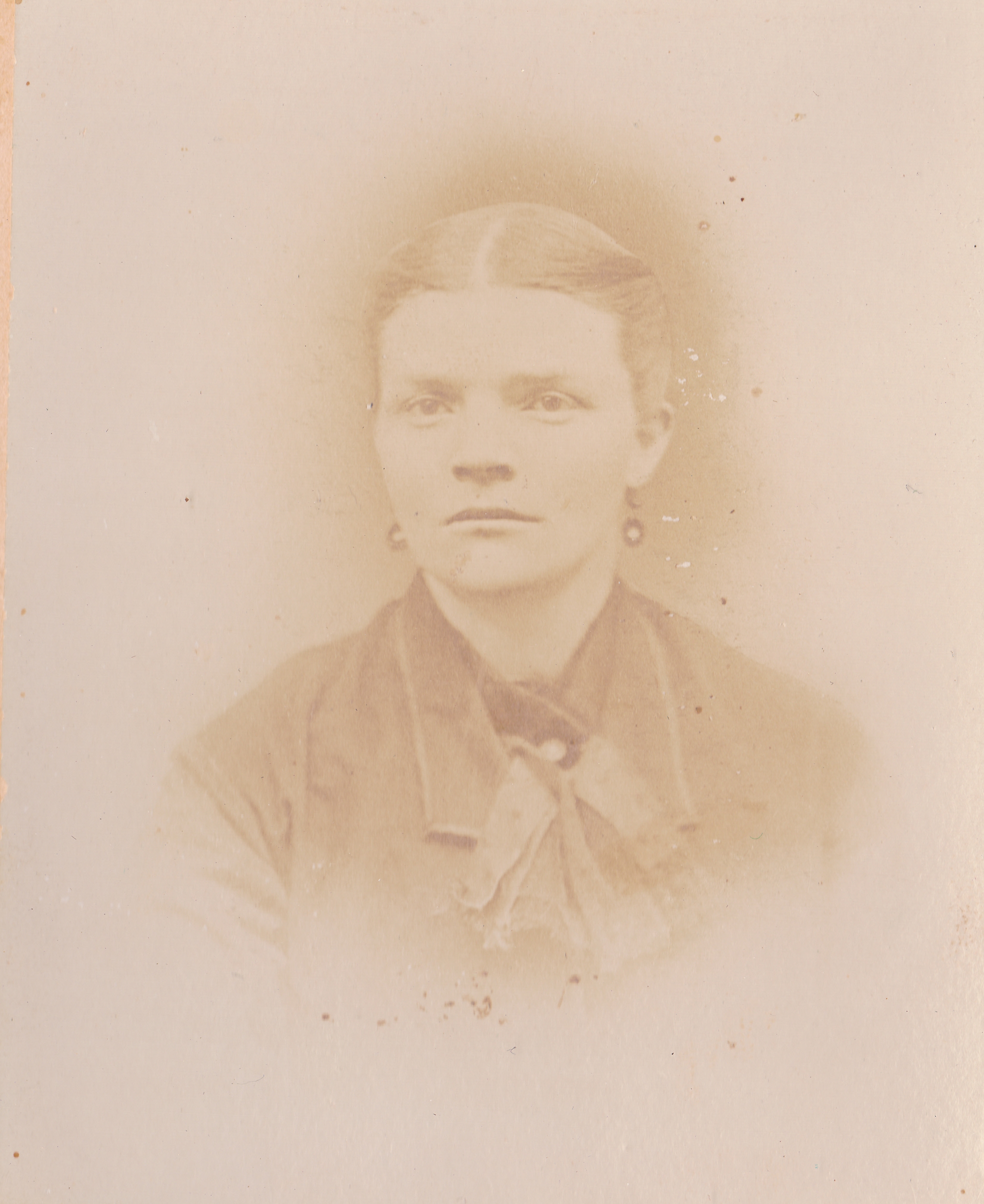
When Mrs. Lund started to write the history of grandma Yardley, she called my attention to the different places of birth on the group sheets found in my Book of Remembrance.I had copied a sheet from someone that gave grandma’s birth date and place as 31 August 1853 in Ogden, Utah. (Afterward, we learned that. she was four years old when she went to Ogden to live.
My sister’s records had 31 August 1852 or 1854 in Pisgah, Iowa, as her birth place. Marie Berrie had 31 August 1853 in Pisgah.
We bought more family group sheets from the Library trying to get a correct date. Herbert Gleave, a relative had 31 August 1853 in Salt Lake City. Loren Hancock dittoed the three other children for Pisgah with 31 August 1853. A relative in Bountiful, Eva Deane Forbes, had 31 August 1853 in Salt Lake City.
Mrs. Lund had found in the book, Pioneers and Prominent Men of Utah that Elisha Barrus Keyes and family had crossed the plains in the Eli B. Kelsey Company in 1852, so she couldn’t accept Pisgah as grandmothers birthplace. She reasoned, that even if grandma had been born in Pisgah, Iowa in 1852, it could not have been 31 August, the date everyone agrees upon. Volume 12, Heart Throbs of the West, says that the Eli B. Kelsey Company, comprising 100 souls left Kanesville, Iowa in July 1852, and arrived in Great Salt Lake City on October 16, 1852. August 31 would make the Keyes family well out on the plains when Isabel was born. No one has ever said she was born on the plains.
More proof comes from Mrs. Lund’s search of the Journal History of the Church on film at the Church Historian’s Library. This gives the name Keyes as being with the Eli B. Kelsey Company, which was the 19th company to cross the plains in 1852.
Further proof comes from the history of grandma’s brother, Elisha Burns Keyes which says he crossed the plains with his parents in the Eli B. Kelsey Company in 1852. He might add that by making a search of all the Captains who headed companies across the plains from 1847 to 1868, this was the only one that Eli B. Kelsey lead.
Mrs. Lund was still disturbed, although. She had proved to her own satisfaction that the correct date and place for grandmas birth was 31 August 1853 in Salt Lake City. She felt that I should have more research made. Realizing that no history can be printed with a contradictory birth date, I engaged the services of Mrs. Triptoe, who had done professional research for our family before. We needed help on other problems in other histories also. Mrs. Triptoe’s search substantiated Mrs. Lund’s findings with a very important addition. She searched the Ward records of the original old Salt Lake City Wards. In the 10th Ward she found the names of Elisha Barrus Keyes and Joanna Worden Keyes as being re-baptized October 30, 1852 in the 10th Ward. This all proves beyond a shadow of a doubt that the Keyes family could not have been in Mt. Pisgah, Iowa on 31 August 1852, nor 1853, nor 1854.
Let us proceed then with the history of Joanna Isabell Keyes by stating that she was born 31 August 1853 in Salt Lake City in the 10th Ward, as Herbert Gleave and other relatives had already established on their submitted family group sheets. Joanna Isabell was the seventh and last child born to ELisha Barrus Keyes and Joanna Case Worden Keyes. Her brothers and sisters were Celia Anzinette, Mary, who died child, Martha, Sarah Ann, Elisha Burns, and Hyrum Henry, died as a child.
In searching the old records of the different Salt Lake City Wards, Mrs. Triptoe found that Elisha and Joanna Keyes lived in the 10th Ward. No doubt this was where grandma was born. We are not prepared to say just when her father moved his family to Provo, but Isabell would only be a small child when her life began there. It seems they were getting along quite well in their new environment, when the father, Elisha Barrus Keyes died on the 27th of September 1855. Little Joanna Isabell was only two years old, so she really never remembered the loving attention of a father. However, she acquired a step-father on the 20th of February 1856, when her 34 year old mother married George Bently Teeples. He was a polygamist and 19 years older than her mother. From all we know he was a good father to little Isabell.
The next year of grandmothers life was spent in Indian country at a place called Fort supply, then in Utah Territory, later in Wyoming. The Fort, which was on the Mormon immigrant trail, was established as an experimental venture by the Church to see if grain and other food stuffs could be raised in that high altitude. It was quite successfully done, and a great help to the thousands of Saints as they trekked toward the Great Salt Lake Valley.
Isabell was not a bit disturbed by the Indians who frequently visited the Fort begging for food and stealing anything they could lay their hands on.
In the late summer of 1857, excitement ran high among the Mormons in the Fort. Word came that a large United States army under the command of General Johnston was marching steadily toward Salt Lake City to wipe out the Mormons whom they had been told were rebelling against the U.S. Government.
Because the Mormons owned Fort Bridger and Fort Supply, the church Authorities took a stand. They did not want to tangle with the army in any way, so the best thing to do was to move the people quickly out of Fort Supply and burn the buildings. The fleeing Saints gathered what crops they could and destroyed the rest.
It can be said that the troops spent a very cold and hungry winter at Fort Bridger. When they marched into the Salt Lake Valley, which was about deserted, peaceful negotiations were reached between Brigham Young and General Johnston and the army marched through the City and established Camp Floyd.
At the time of the exodus from the Fort, Isabell’s family moved to Ogden, in Weber County. Because the next few years of grandmothers life was spent in this place, let’s throw in a few interesting facts about the first settling of Ogden taken from the weber county book. It will be very briefly told.
Captain James Brown of the Mormon Battalion, acting for President Brigham Young, paid $1950 he had brought from California to Miles Goodyear, a trapper, for his immense holdings; this transaction took place on the 24th of November 1847, Goodyear claimed that he had been given this tract of Land by the Mexican government, but a deed of ownership was never found.
Some Mormon families joined Brown in February 1848 and more in the spring. A large group came in the fall of 1849 and from then on the population steadily increased.
It was already a prosperous community when the Saints left Fort Supply and swelled its numbers. However, the Teeples families found the people of Ogden very much stirred up at the reported entrance of the 2,500 soldiers into Utah.
No doubt George Teeples was a member of one of the Utah units of the Nauvoo Legion, that stood guard at the mouth of Echo Canyon.
Following the instructions of President Young the people of Weber County took what supplies they could take with them, put straw in their homes so they could be burned if need be, and proceeded south to the Provo Bottoms which had been selected as a temporary camp for them.
When trouble was averted, the people were so glad to return to their homes again in the fall of 1858.
Even though grandma was only five years old when all this excitement took place, it no doubt made a lasting impression on her mind.
We must mention here the additions to the family circle. Her mother gave birth to a daughter, Rhoda Elvira Teeples on September 23, 1857 at Fort Supply. Jacob Amos was born in Ogden on February 5, 1860. Then twin girls, Antoinette and Marietta were born on September 27, 1862, also in Ogden. They died as children.
Grandma’s childhood and adolescent years were spent in Ogden. She was able to receive the same amount of education afforded the young people of that community. She was taught the rudiments of home making by her mother and was given responsibility in the home and to help in the care of her younger sister and brother.
Grandma’s two older sisters, Celia and Martha were both married to Alma Taylor. Her brother Elisha lived with and worked for a family in Ogden. We have no information about Sarah Ann only the group says she died in 1899. However, Pioneers and Prominent Men, a book says she died an infant.
Your writer was very disturbed trying to find out how Joanna Isabell Keyes of Ogden, and Thomas Yardley of Parowan became acquainted. After persistent searching, the answer came in the history of her brother Elisha Burns Keyes. He mentions that he went to Parowan to visit his mother who was living there. Oh happy day–now we know.
It would be most interesting to know something of the teenage life of Isabell in Parowan. In which part of town the family lived, who her friends were and something about her courtship with Thomas Yardley. But the fact remains that they must have had great love for each other and they were married on the 30th of January 1871 in Parowan. Joanna Isabell was 17 and Thomas was 22.
From the group sheet at hand we note that they were endowed and sealed in the Salt Lake Endowment House on the 27th of. February 1871. That would show that they left immediately by team and wagon for Salt Lake City in the dead of winter to be sealed for time and all eternity. It took them about a month to make the trip.
They made their home in the East part of Parowan. They were pleased to welcome their first born son on the 7th of November 1871. They gave him the name of Thomas William. A faithful and knowledgeable midwife assisted grandma at the birth of all her eleven children. Just two months before her second child was born, on March 17, 1873, little Thomas William was taken by death on January 27, I873. James Gilbert grew to maturity and later married Mary Jane Fowler. He died October 23, 1943. The third child was Tessa Estella born April 8, 1875; md-James E. Goff and died November 13, 1896. 4, Alice Minerva; b-9 March 1877-md-Joseph Stevens Jr. and became our parents. She died 27 December 1956. 5. Celia Isabell; b-26 January 1879- md-Frank Leslie Culver-died 23 February 1959. 6, Ervin Elisha; b- 23 February 1881-md-lst Ethel Benson. She died and he md-2nd Marie Ovedie Kofoed-died 30 October 1938. 7, Sarah Emma; b-19 January 1883-died 5 July 1899-unmarried. 8, Joanna Marietta; b-17 February 1885-md-1-Robert Russel, 2nd George Nagle-died 16 or 17 September 1946. 9, Leslie Clinton; b-4 February 1887-died 11 Jan. 1933-unmd. 10, Raymond; b-6 June 1889-died child-2,7 September 1889. 11, Russel Samuel; b-8 November 189l-md-Ethel Gill-died-19 April 1962.
Grandma’s life would certainly be taken up with the care of her large family, In those days, all the meals had to be prepared from “scratch”, from the things they produced themselves, of course they bought a few things from the store like sugar, salt, spices etc.
The clothes had to be scrubbed clean in a tin tub with a wash board, with water carried from the irrigation ditch and heated in a boiler on the wood burning stove. She used soap she made herself from scraps of fat and lye. The ironing was done by heavy hand irons heated on the kitchen stove. There was always sewing to be done to keep them neatly clothed. Also quilts had to be made to keep the family warm during the cold winters. There was a vegetable garden to raise, apples and plums to dry for winter use, chickens to tend and meat to cure.
Her biggest concern was to teach her children to live good lives.
In mother’s history, in possession of Marie Topham Berrie; she mentions that her father built a nice six room home on the farm two miles northwest of town and her last two brothers were born there. This would be about 1888.
Mother also relates a very exciting experience the family had there on the farm when two groups of Indians had quite a battle among themselves. Grandpa thought it safer to get his family away from there before any of them were harmed. The Indians were shooting at each other at the back of the house so he couldn’t get a team and wagon. The only thing to do was to take out on foot from the front of the house. Quietly sneaking out under cover of darkness they used the tall clover and willows along the ditch bank to conceal their whereabouts and made it safely to town.
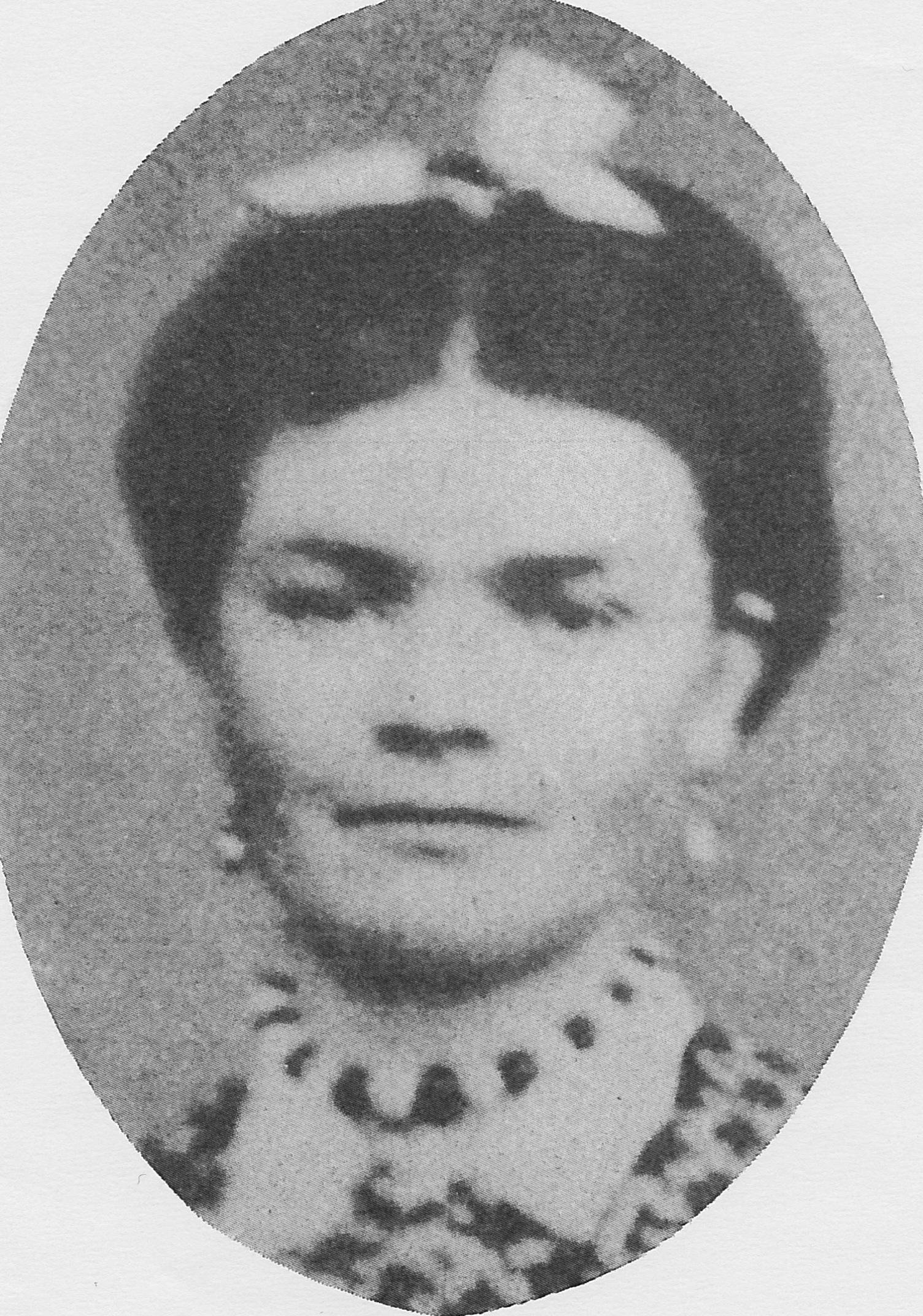
Of course, none of us ever saw our dear little grandma Yardley, but we are privileged to have her picture. It shows her to be a very pretty young woman, with a kind, sweet, intelligent look on her rather round face. Her dark hair is parted in the middle and drawn loosely back to a bow, with a white or light colored bow of ribbon on top of her head. Her dress is of a printed design, perhaps black and white, with a broche at the front of a white pointed collar, a choker necklace and long earrings complete her attire. We have no idea how old she was when this picture was taken.
It is hard to understand why a young mother with nine children, not any of them married at the time, could be needed on the other side more than here with her family. She was only 38 years at the time of her passing, on the 19th of February 1892. It seems that she had not fully recovered from the birth of her last child. After a fitting funeral service, she was sorrowfully and lovingly laid to rest in the Parowan Cemetery on the 21st of February 1892. Grandpa stayed true to his first love, and found solace in the welfare of his children.
When he and his son Russel decided they could do better in the north, they left Parowan. After farming on the Provo Bench awhile, they moved to a farm in the Gunnison Valley. When grandpa’s health failed to the extent that he had to be hospitalized, he was taken to the Salina hospital where he passed away on the 29th of June 1921. He was taken back to Parowan for burial beside grandma in the beautiful cemetery there.
We know there would be great rejoicing when they met and grandma would certainly tell him how proud she was of their family and what a good job he had done in rearing them.


Leave a comment