


The area of Nauvoo was first called Quashquema, named in honor of the Native American chief who headed a Sauk and Fox settlement numbering nearly 500 lodges. By 1827 white settlers had built cabins in the area. By 1829 this area of Hancock County had grown sufficiently so that a post office was needed and in 1832 the town, now called Venus, was one of the contenders for the new county seat. However, the honor was awarded to a nearby city, Carthage. In 1834 the name Venus was changed to Commerce because the settlers felt that the new name better suited their plans.
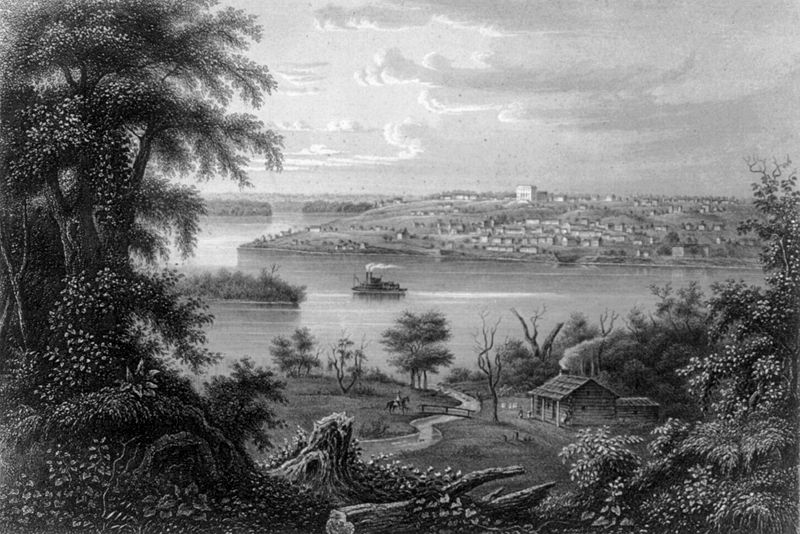
In late 1839 arriving Mormons bought the small town of Commerce and in April 1840 it was renamed Nauvoo by Joseph Smith, Jr., the founder of the Latter Day Saint movement. The name Nauvoo is derived from the traditional Hebrew language with an anglicized spelling. The word comes from Isaiah 52:7, “How beautiful upon the mountains…” It is notable that “by 1844 Nauvoo’s population had swollen to 12,000, rivaling the size of Chicago” at the time.
After Joseph Smith’s assassination by a mob in 1844, the population of Nauvoo was subject to considerable change. In 1849, Icarians moved to the Nauvoo area to implement a utopian socialist commune based on the ideals of French philosopher Étienne Cabet. At its peak, the colony numbered over 500 members, but the death of Cabet in 1856 caused some members to leave this parent colony and move elsewhere. In the early and mid 20th century Nauvoo was primarily a Catholic town, and the majority of the population today is Catholic.
On the city’s higher ground are the temple, residential areas, and the business district along Mulholland Street (Illinois Route 96), much of it devoted to the needs of tourists and those interested in Latter Day Saint history. The flatlands are occupied by a small number of 19th century brick houses and other buildings that have survived the city’s vicissitudes, with large empty spaces between them where houses and whole neighborhoods have entirely disappeared.
Community of Christ owns much of the southern end of the flatlands and maintains several key historic sites located in and around Nauvoo. These sites include the Joseph Smith Homestead, the Nauvoo House, the Red Brick Store, the Mansion House, and the Smith family cemetery overlooking the Mississippi River that is the final resting place of Joseph Smith, Jr., his wife Emma, and his brother Hyrum. Guided tours are available at the church’s Joseph Smith Historic Site, located at the south end of the town and accessible from Highway 96.The Church of Jesus Christ of Latter-day Saints (LDS Church) owns most of the other historic sites in Nauvoo, including the homes of Brigham Young, Heber C. Kimball, and other early members of the church, as well as other significant buildings.


Leave a comment